WONG HOU UN
Computer Science & Philology
A Software Engineering student studying Computer Science, Machine Learning, and Computational Linguistics. Born in Macau, where ancient texts and modern technology meet.
About Me
I am a software engineering student hailing from Macau. This origin instilled in me an innate love for languages and history, which I now strive to combine with my technological studies. Besides computers and languages, I have a profound passion for mathematics; I frequently spend time online calculating integrals and discussing linguistic concepts with friends.
In technical fields, my focus lies in Machine Learning, Computer Vision, and System Security. I take great pleasure in creating and debugging new tools, ranging from neural networks to automated software.
In the humanities, I am deeply devoted to Philology, Ancient Languages, and Comparative Grammar. My objective is to bridge these two disciplines: utilizing modern computational tools to decipher ancient texts and advance computational philology.
Academic Works (Courses)
During my academic journey, I have completed numerous projects to put theory into practice.
- Object-Oriented Programming: “MineMatching” game in JavaFX.
- Database Design: Management system for car repairs.
- Software Engineering: Web application for restaurant reviews.
- Computer Vision: TriStreamNet model for detecting AI-generated images.
- Cryptography: Playfair Cracker via Simulated Annealing and DFS.
- Principles of Programming Languages: KanbunSE, an S-Expression language written in Classical Chinese. Online Editor Classical Chinese → VS Code Extension →
- Data Structures: HTML Tree Parser in C++ Qt.
- Software Design: Game of Life in CLI.
Featured Projects
Terminal Vision (TermVis)
Watch video streams and monitor CV models directly over SSH — no X11, no GUI required.
TermVis addresses the pain of streaming video over laggy remote connections. It converts frames into high-fidelity half-block characters (
▀) with 24-bit color. It also employs Delta-XOR + Zlib incremental compression and on-the-fly Fourier (DFT) sharpening to preserve edge detail.Key Features:
- High-Res Rendering: 24-bit color mapping directly in terminal.
- Compression: Only diffs are compressed and sent.
- Engine: A Rust core executing pixel manipulation off the Python GIL.
Rust Python OpenCV SSH Fourier
Demo: Mirroring a 1080p physical display via SSH with Fourier sharpening.
KanbunSE (Kanbun S-Expression)
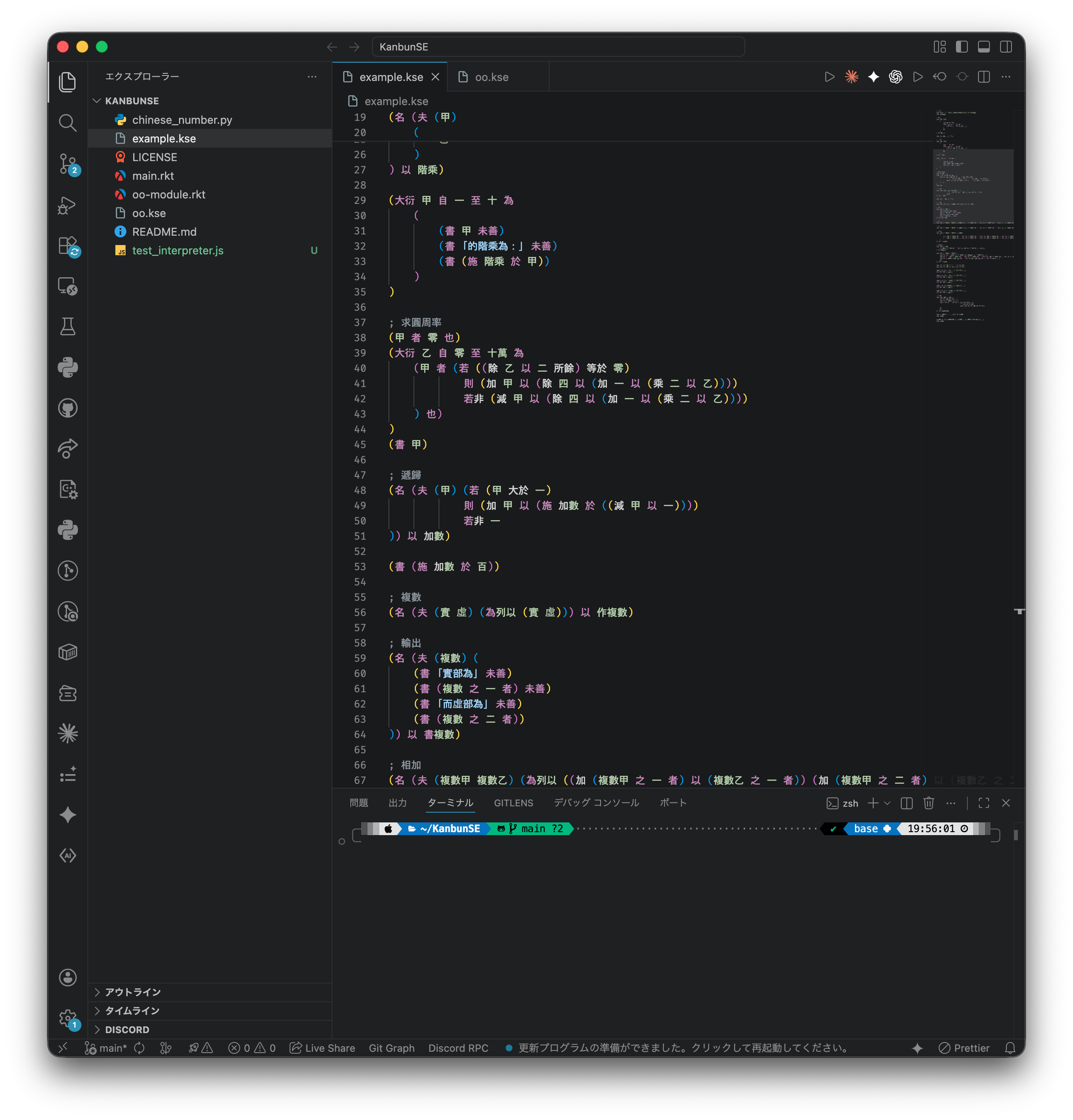
An S-Expression language written in Classical Chinese to advance computational philology.
KanbunSE is an interpreter and toolset that allows users to write programs using ancient (Kanbun) vocabulary and syntax. The project aims to build a bridge between the technical world and the humanities.
Key Features:
- Interpreter: An engine that reads and executes Kanbun S-expressions.
- VS Code Extension: A tool for writing with syntax highlighting and auto-completion support.
- Philology: Facilitates the analysis of ancient texts through modern computational tools.
TypeScript S-Expression Classical Chinese VS Code Extension
Cloud System & Data Repository (LHDrive)
I developed a file management system and data repository for my secondary school (Lou Hau High School). This system provides users with an intuitive web interface. It is highly robust, remains in daily use by students and teachers, and can be accessed at drive.louhau.edu.mo.
Key Features:
- File Management: A comprehensive system for uploading and downloading files, organized efficiently into folders.
- File Sharing: The ability to easily share files with other users across the platform.
- Shared Admin Folders: Secure, separate spaces where school administrators can collectively manage and distribute public documents.
PHP Vue.js cURL Full-Stack Hand-Coded

Blogs & Networks
HARUMOTO HATENA BLOG
My personal weblog, where I delve deep into my academic interests. Here, I publish detailed solutions and proofs for complex mathematical problems (such as the MIT Integration Bee, Feynman's integration trick, and infinite series). You can also find my competitive programming logs (AtCoder) and notes on reading Classical Chinese texts (Kanbun Kundoku).
THREADS (@harumoto1103)
My primary social network. Here, I frequently explain mathematical integrals (e.g., via substitution and complex analysis) and discuss language and grammar inquiries with my followers.
Contact
- Email: harumoto1103@gmail.com
- GitHub: github.com/harumoto1103