Academic Works & Projects
Below are the primary projects I have completed during my university courses.
Deep Learning
Food Recognition & Calorie Calculation
A Diet Inquiry System via Lightweight Models A project completed for the “Deep Learning” course. It is an end-to-end system designed to track dietary intake and provide health advice, specifically built to operate locally on mobile devices without an internet connection to protect user privacy.
Key Technologies:
- Computer Vision & Validation: A YOLO neural network detects food within images, estimating volume using the Shoelace formula. A CLIP model then validates these detections (acting as a Gatekeeper) to prevent misclassification.
- Data Retrieval: TF-IDF and Word2Vec algorithms are employed to search massive local databases (“RecipeNLG” and “USDA Food Central”).
- LLM Reasoning: A lightweight SmolLM2-360M language model (with 4-bit quantization and a LoRA adapter) is used to estimate calories and provide personalized advice in JSON format. The total memory footprint is only about 2.75 GB, making it highly suitable for mobile deployment.
Python YOLOv5 CLIP SmolLM2 NLP
Object-Oriented Programming (OOP)
“MineMatching” Game in JavaFX “MineMatching” is a tile-matching game built with a “Minecraft” theme. The software architecture clearly demonstrates object-oriented principles (such as encapsulation and polymorphism). An abstract
Piececlass is extended by derived classes (likeEliminatororWall), allowing all elements to be managed seamlessly within a single 2D array matrix.
- Board & Elements: Includes five types of elements: Normal, Eliminators, Special (e.g., a diamond sword to clear columns), Walls (introduced in Level 6, which cannot be moved), and empty slots (Nulls).
- Tools & Levels: Features six playable levels. Players can use a “Hammer” tool to destroy a single block (earned by matching five blocks simultaneously) and a “Restoration Potion” to undo the last move.
- Interface: Comprises four GUI views (Start, Game, Menu, End), allowing users to play by clicking or dragging the mouse.
You can review the code and documentation (in Chinese) below:
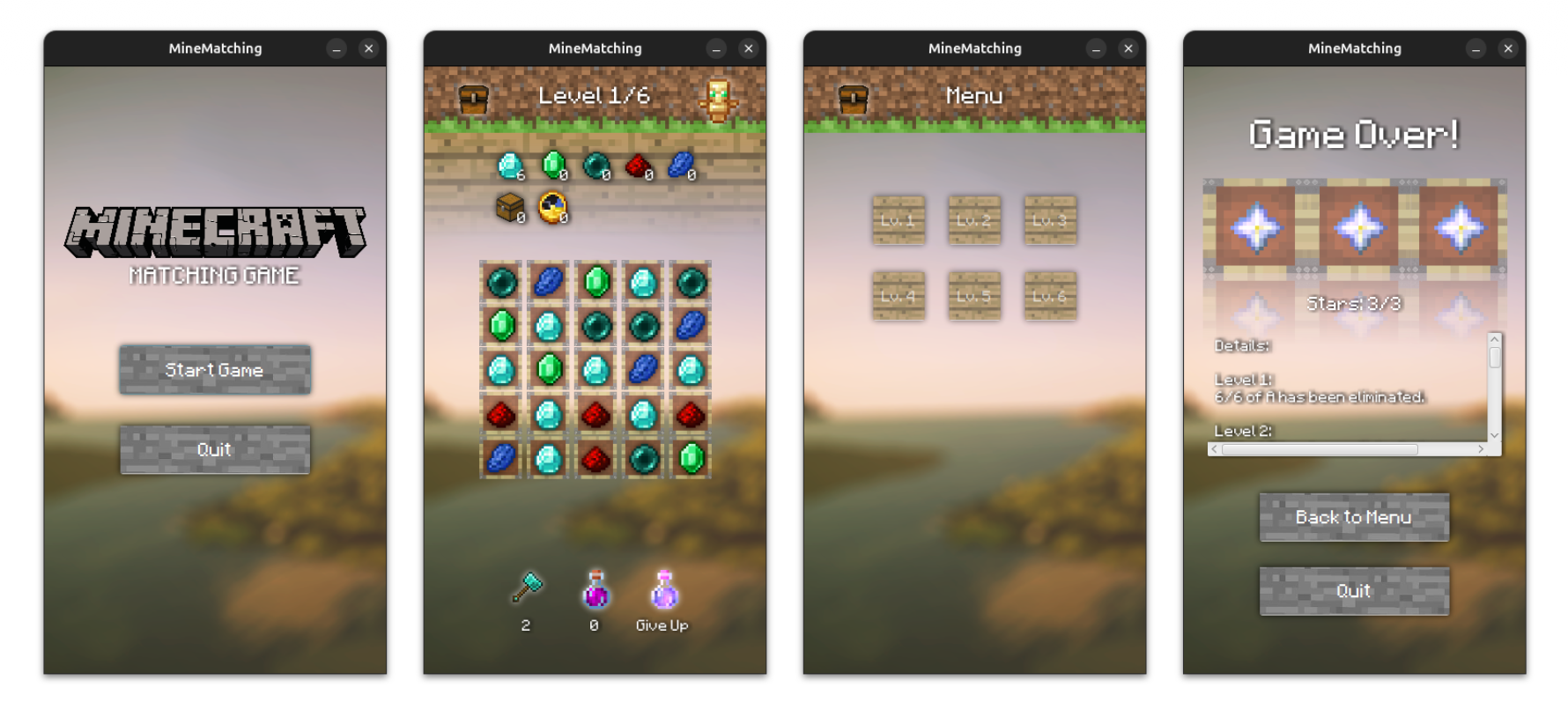
Image: The MineMatching game board showcasing various elements and items.
Computer Vision
TriStreamNet: A Model for Detecting AI-Generated Images This project performs binary classification (Real vs. AI-Generated). The TriStreamNet architecture utilizes three distinct streams:
- RGB Spatial Stream: Employs a ResNet18 network to capture colors and textures.
- Frequency Stream: Utilizes Fast Fourier Transform (FFT) to detect periodic artifacts.
- Noise Stream: Applies SRM filters to extract anomalies in noise distribution. The final accuracy on the test dataset was 75.90%.
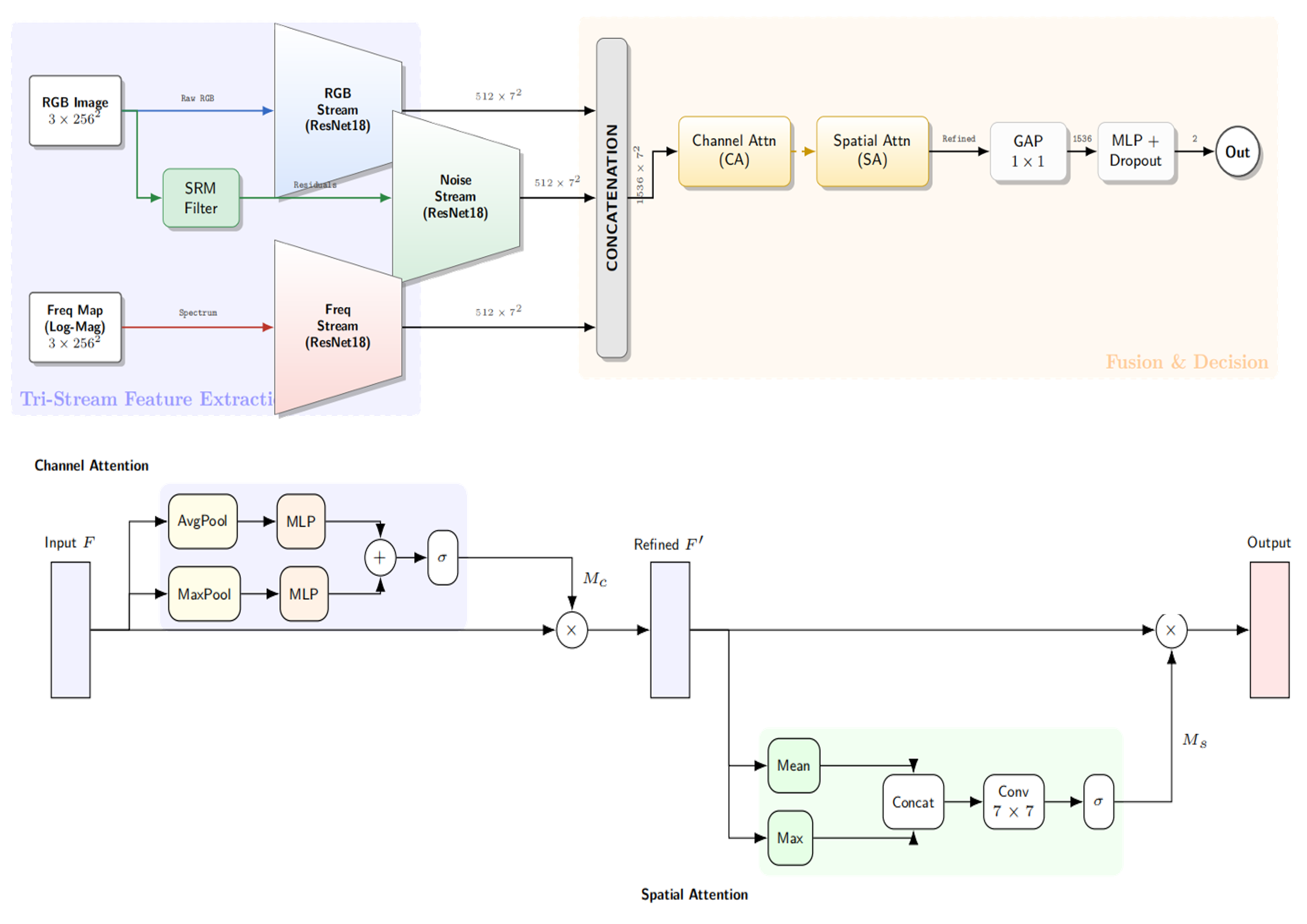
Image: The TriStreamNet architecture featuring three streams and CBAM attention.
Cryptography & Information Security
PlayfairCracker: A Multi-Algorithm Suite for Cracking Playfair Ciphers This project implements several advanced techniques to break the Playfair cipher. It features a base implementation using Simulated Annealing in C and a highly optimized, multi-threaded cracker in Rust using frequency analysis and deterministic search.
- Simulated Annealing (C): Employs key mutation and probabilistic acceptance (Metropolis criterion) to navigate the large key space and converge on the optimal plaintext.
- DFS Search & Parallelism (Rust): A high-performance cracker that uses frequency-based deduction (bigrams and quadgrams) and a Depth-First Search with aggressive pruning based on Playfair’s geometric rules. Parallelized with Rayon to handle millions of tasks across all CPU cores.
- GUI Interface: A visual tool developed via “Vibe-Coding” that allows users to monitor the cracking process and see the matrix reconstruction in real-time.
C Rust Cryptography Simulated Annealing GUI
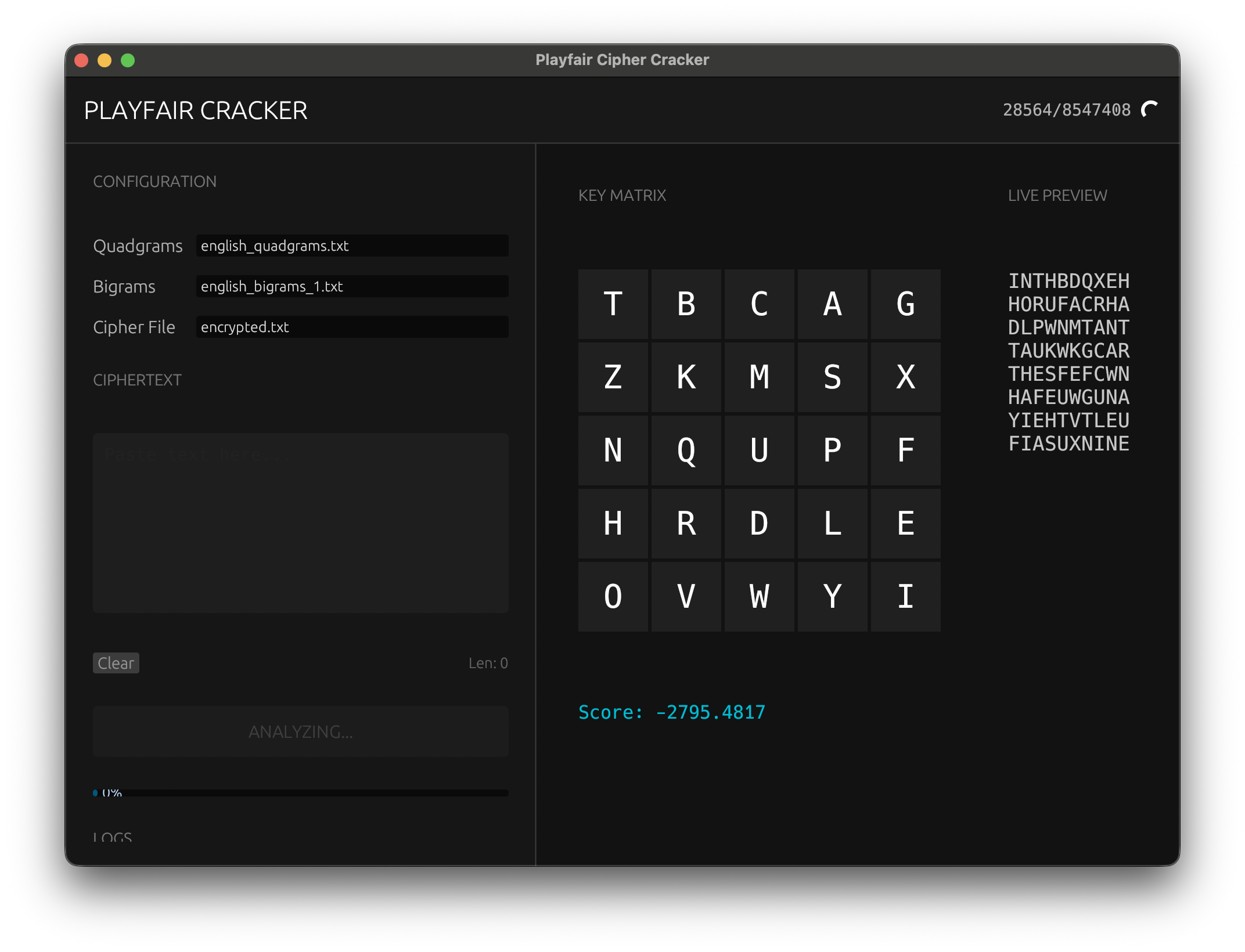
Image: The PlayfairCracker GUI demonstrating real-time matrix reconstruction.
Principles of Programming Languages
KanbunSE: An S-Expression Programming Language KanbunSE Online Editor → VS Code Extension → (Kanbun S-Expression) is a language I created to bridge Classical Chinese literature and modern computation. It elegantly combines the syntax of Classical Chinese with an S-Expression structure.
Key Features:
- Object-Oriented System (OOP): Fully supports abstract and inherited classes, polymorphism, and the keyword
此(this) for self-reference in methods.- Numbers & Data Types: Automatically converts Arabic numerals into Traditional or Formal Chinese numerals (e.g., 三百一十四點一五 for 314.15) via Python integration. Boolean values are represented as 陽 (Yang, True) and 陰 (Yin, False).
- Error Handling: Contextual errors are reported entirely in Classical Chinese. For example, an index out-of-bounds error reads: “索驥圖外、其轍亂矣” (Seeking a steed beyond the map, its tracks are lost).
- Internal Architecture: The interpreter is built in Racket. It features lexical analysis, a recursive descent parser, and an Environment Chain for lexical scoping.
You can review the code and documentation (in English) below:
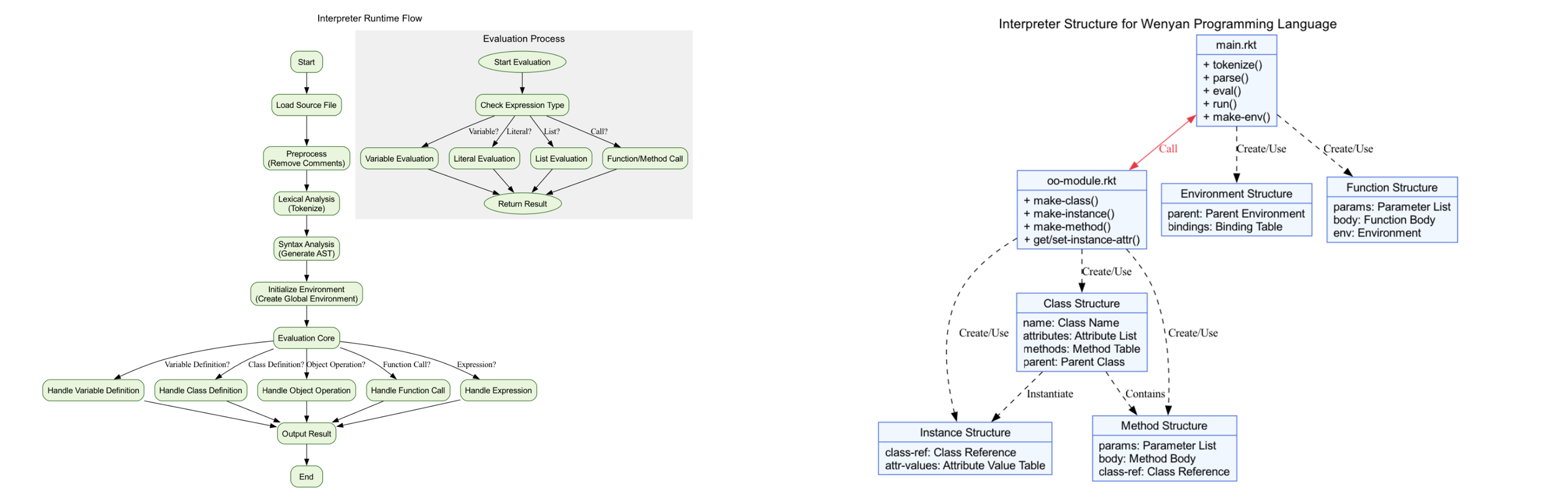
Image: Interpreter structure and execution flow of KanbunSE.
Database Design
Car Repair Management System A database system designed for car repair businesses. It features three user roles: Customers, Mechanics, and Administrators. The system utilizes SQL transactions to maintain data integrity and triggers to handle cascade deletions safely.
Software Engineering
Restaurant Review Website I built a web application where users can search, locate, and leave reviews for restaurants. The system is fully operational and backed by a robust design.